ANTON

Operator-led AI harness designed for M&A and investment professionals

Designed to reduce the two biggest operational risks in AI-assisted dealmaking: data leakage and mathematical hallucinationsLLMs analyze CIMs, VDR docs, and NDAs to route information and draft investment committee narratives, while a deterministic Python engine strictly executes your LBO and DCF modellingVault structured as a second brain, consolidating information across Outlook, news, meeting notes. Available on demand to prepare agendas, track DD and draft deal materialsCrucially, strict data governance ensures your highly confidential deal materials remain confidential*

* Data confidentiality is maintained by running sensitive documents on local LLMs or enterprise subscription models by default

111·49endpoints / routers
3,871tests passing
4autonomous crews
27routine modules
MITlocal-first

Built to produce genuine first-drafts and actionable insightsFrom LBO models to targeted IC memos, every output is heavily structured, fully sourced, and operator-gated

See it in action

The single-operator cockpit over a Markdown vault — the same deal flows through every lane, with the sensitivity guard and audit trail wired through for institutional compliance.*

* Shown with synthetic demo content

The cockpit
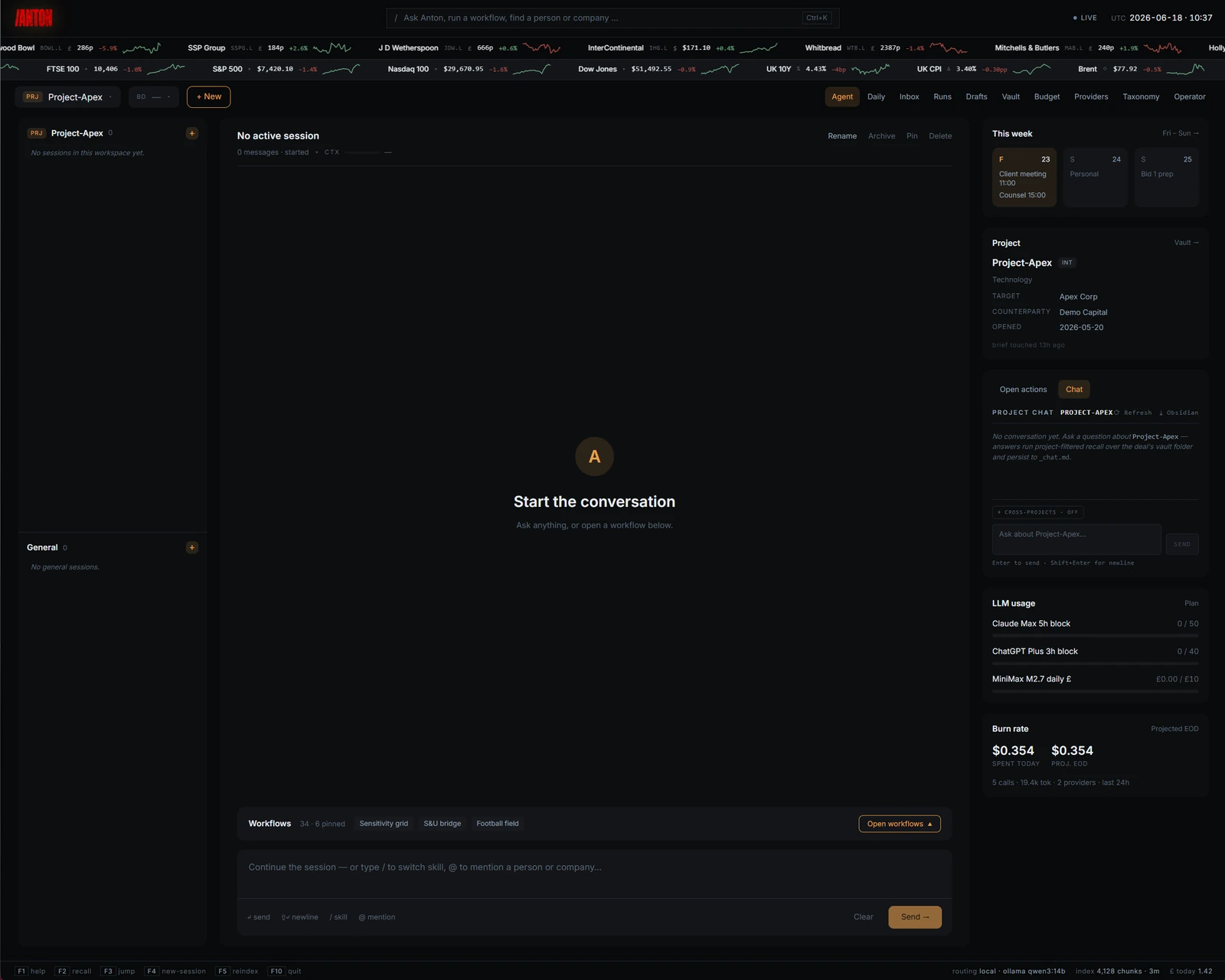
ANTON agent cockpit with the workflow drawer closed — chat-first
Chat-first — workflow drawer closedThe default is a clean composer over the sessions for the project: live markets, your week, the project rail, and real-time token spend. Interrogate deal docs or search Vault content in plain language. Quick start new project or general sessions.
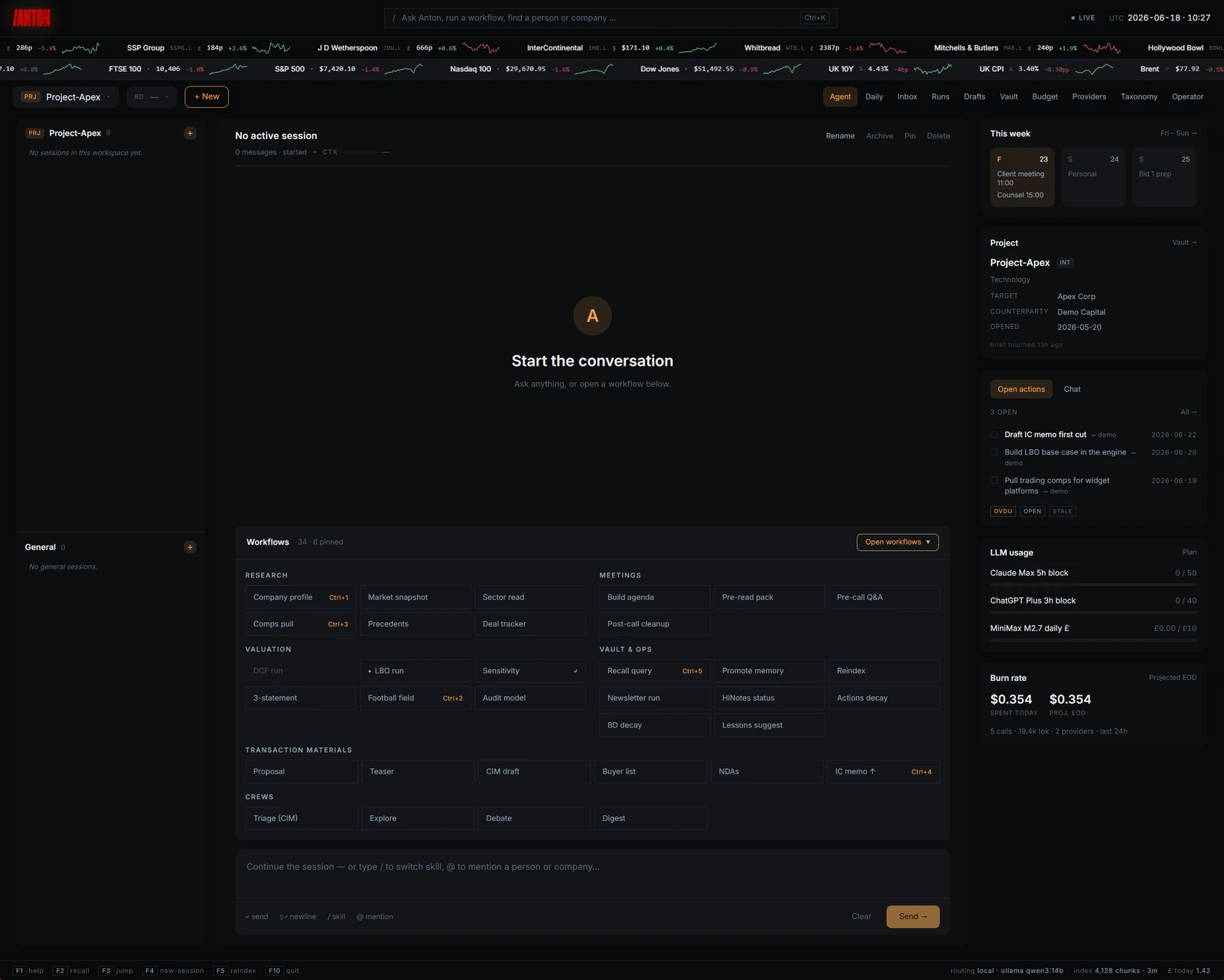
ANTON agent cockpit with the workflow drawer open — the full skill palette
…one keystroke opens the workflow drawerThe full dealmaker's palette — target screening, valuation, management meetings, and transaction materials (teasers, CIMs, IC memos) — each a governed skill you fire with a click or a hotkey.
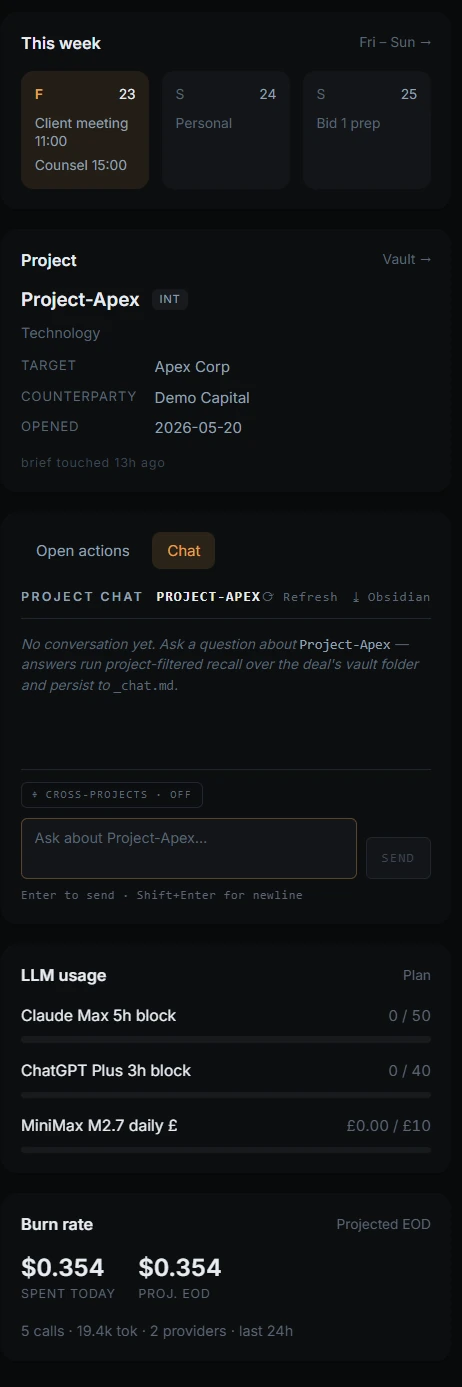
Per-deal project rail and vault-scoped chat
A workspace per dealEach deal gets a dedicated project overview — stage, target, sponsor, key dates — and a chat that runs recall strictly over that specific transaction's vault folder.
Valuation, three ways
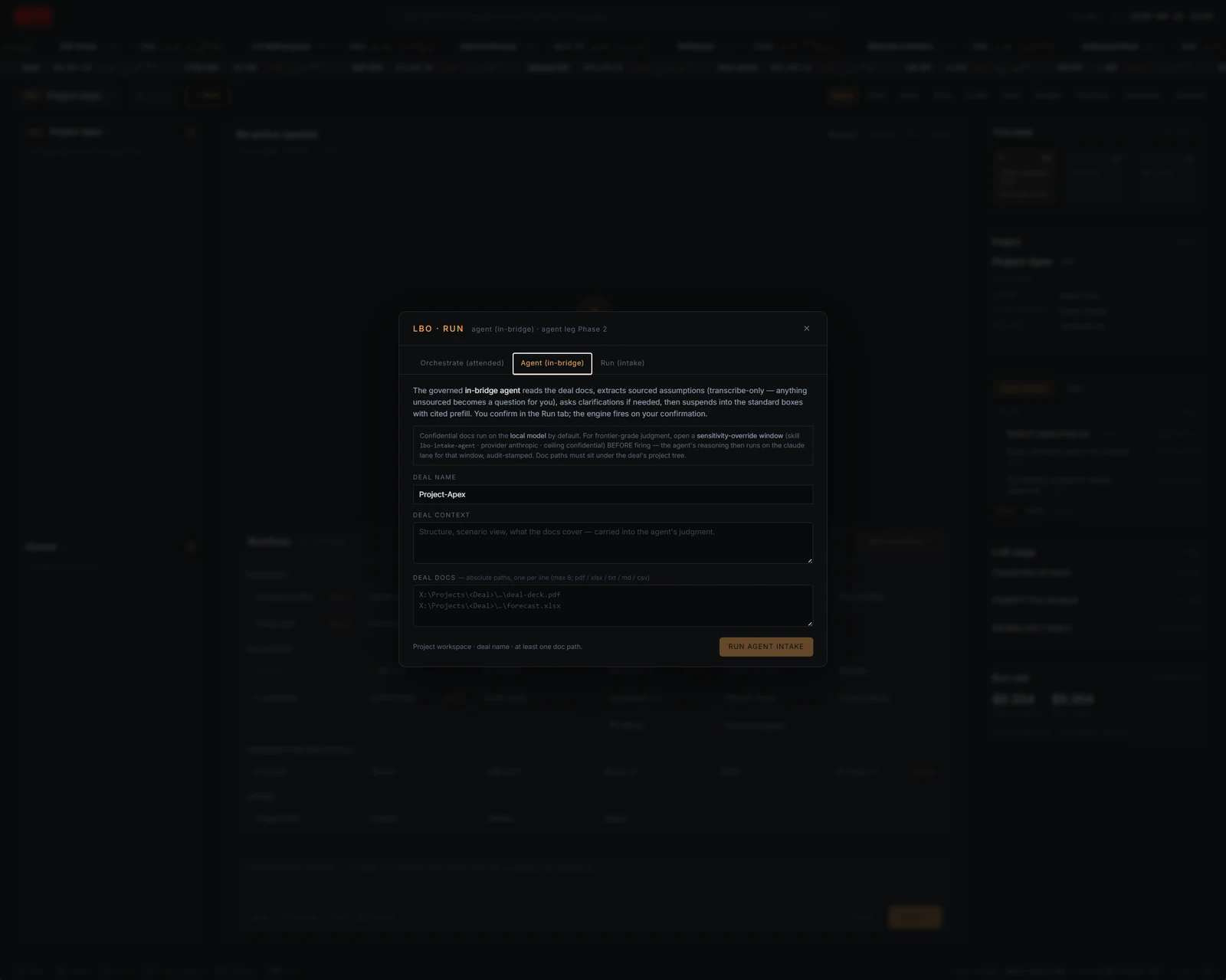
Governed in-bridge LBO intake agent
Governed intake, not a black boxThe LBO agent reads the CIM and transcribes only sourced assumptions — anything unsourced becomes a question for the operator to sign off on.
Paste-ready orchestration prompt for an attended CLI run
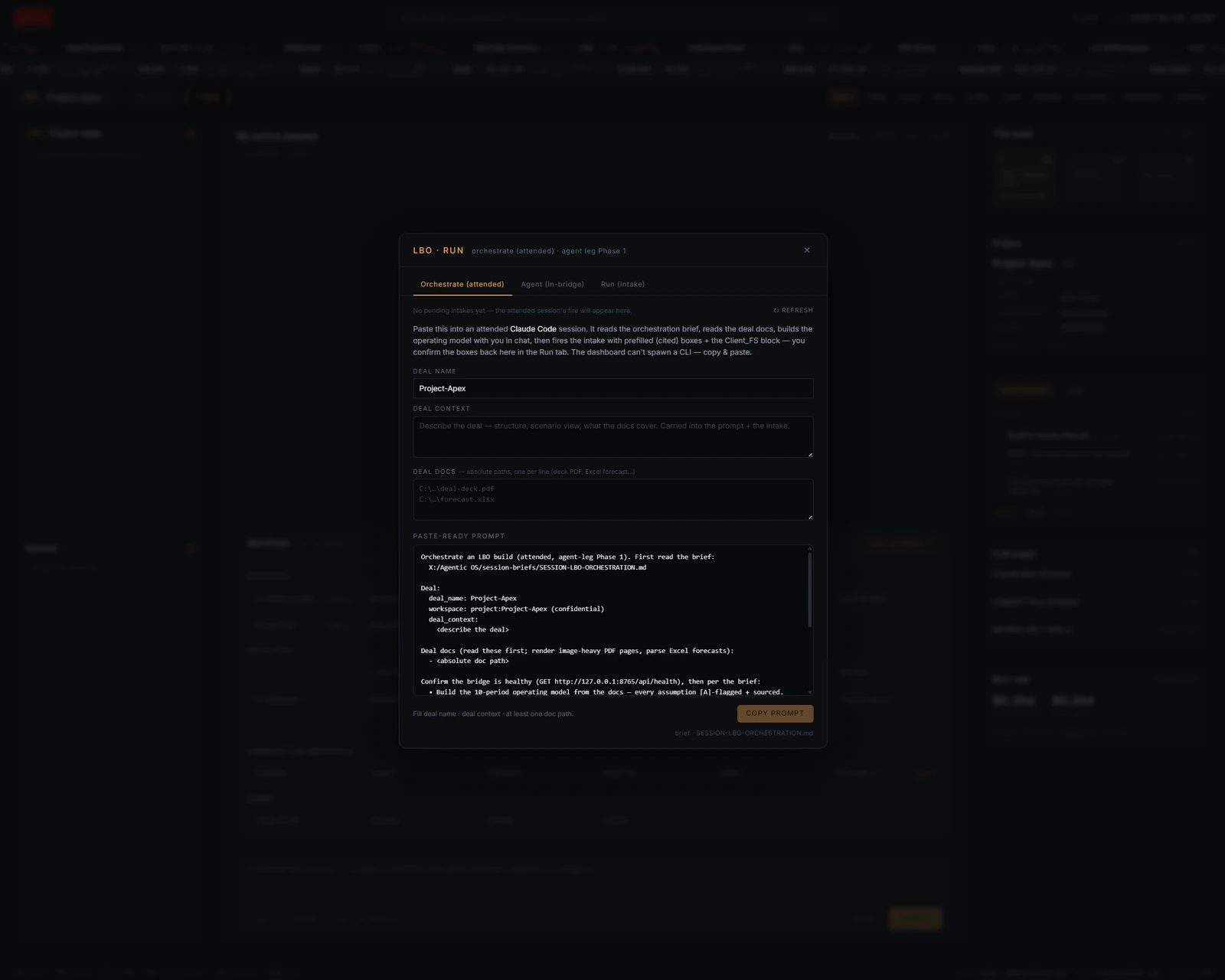
Or drive it from the CLIA paste-ready, fully-specified prompt for an attended Claude Code run — same governed intake, same rigorous sourced-assumptions discipline.
Deterministic LBO engine intake form
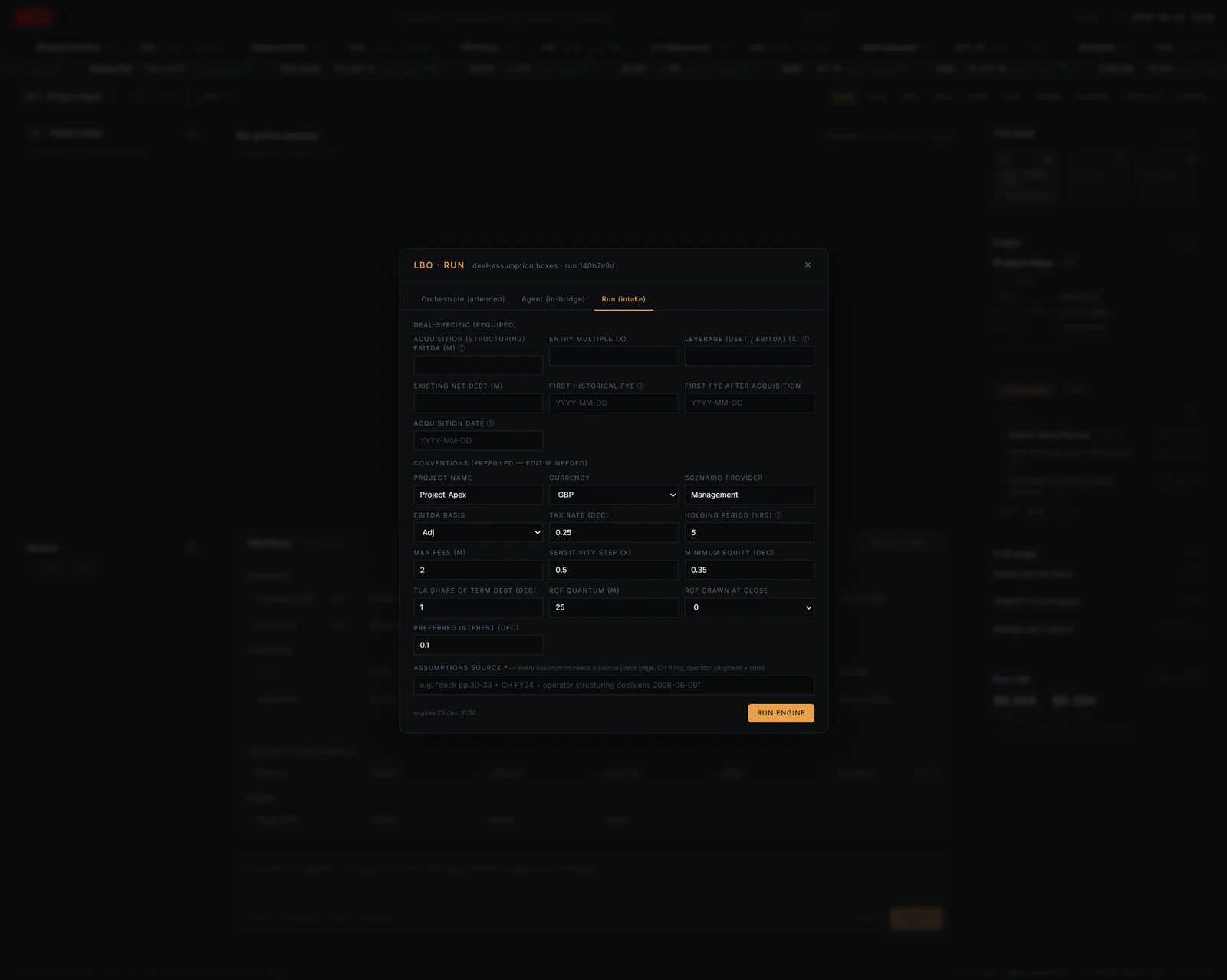
The engine does the mathsOperator approves inputs and assumptions; a deterministic Python engine drives your proprietary Excel model cell-by-cell. No LLM ever computes a number.
Confidentiality-aware routing & budgets
Per-skill and per-crew model routing, cloud-fallback ladder, MNPI attestations
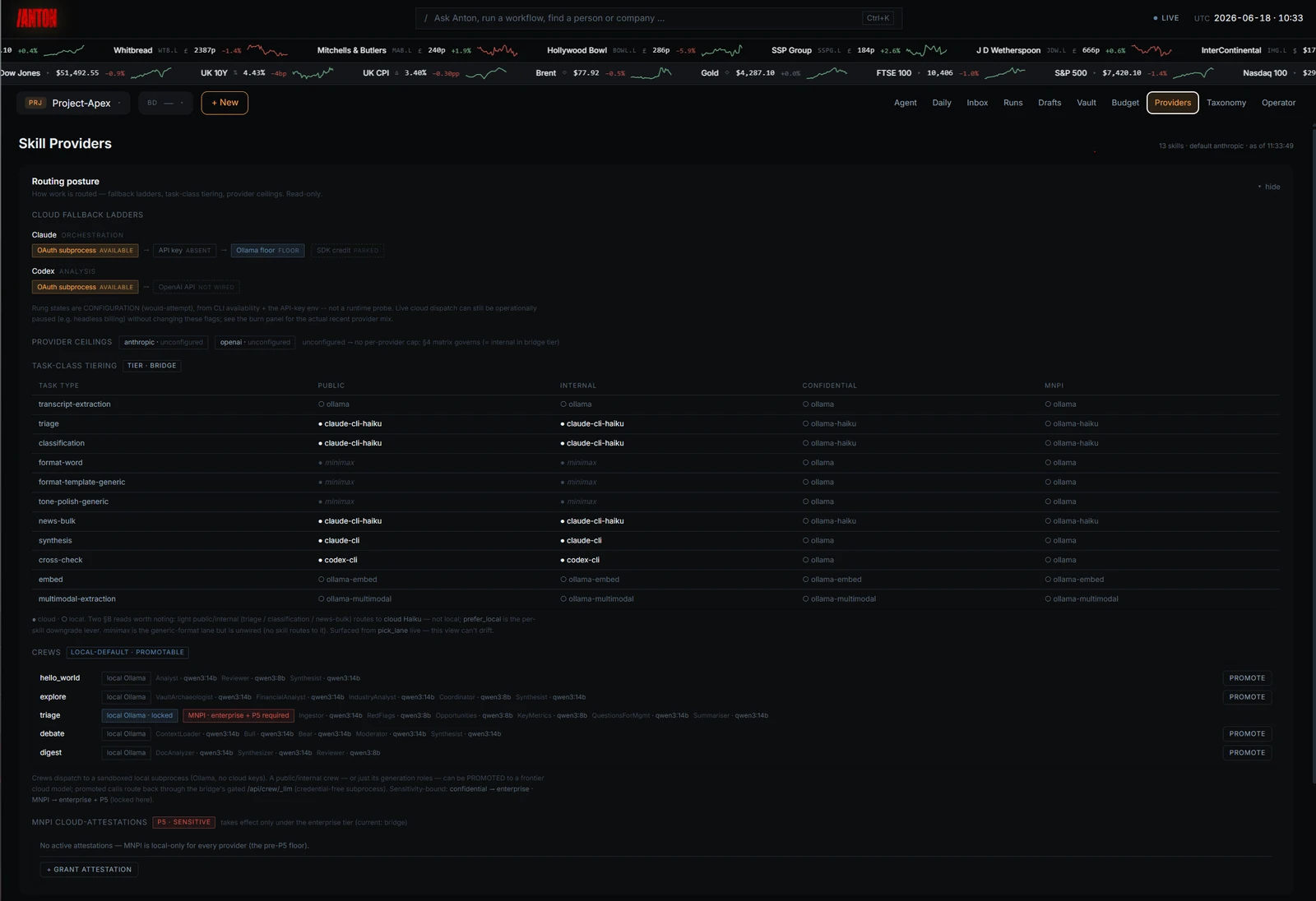
The guard, made legiblePer-skill and per-crew model assignment, the cloud-fallback ladder, and MNPI cloud attestations — confidentiality-aware routing you can actually see.
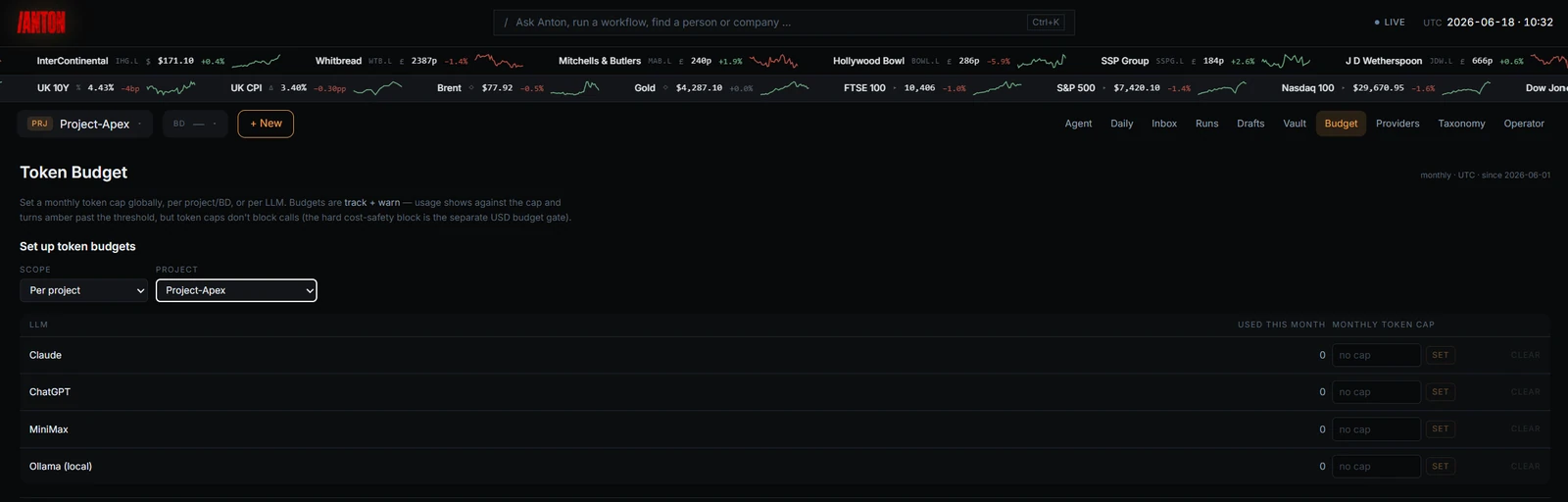
Per-model token budget caps and monthly usage
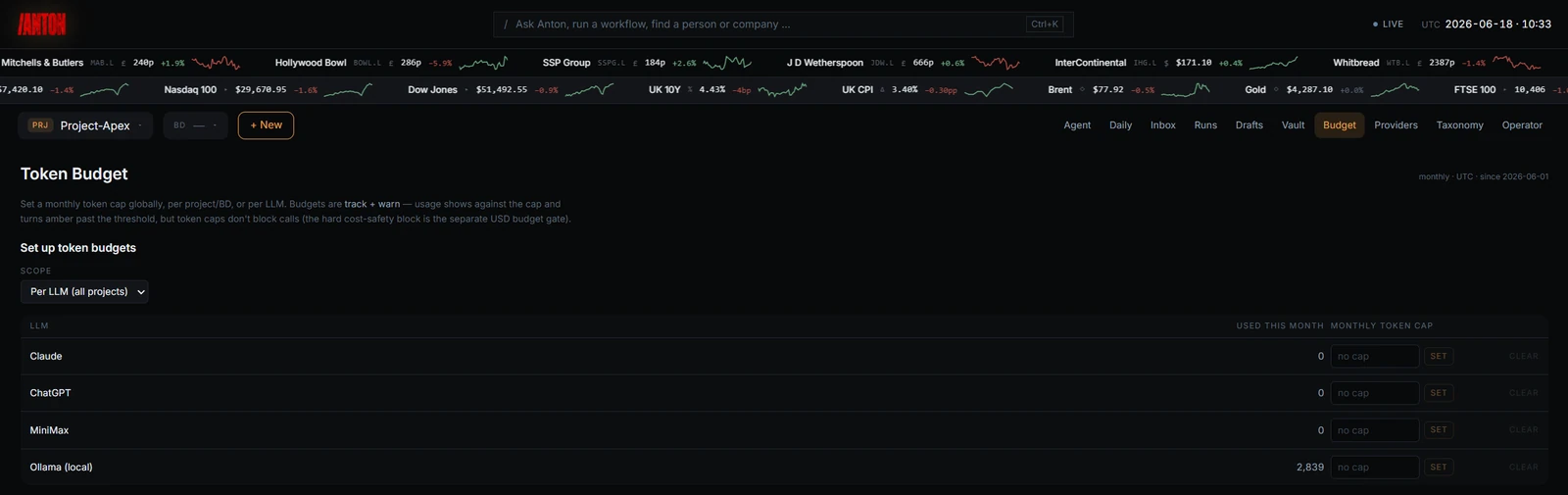
Token budgets and capsSet monthly caps globally, per project, or per model; usage tracks against the cap and warns before it bites — the hard cost block is separate.
Per-project token budget — a cap scoped to a single deal
…or scoped to a single dealCap one project and track every model against it — Claude, ChatGPT, MiniMax, local Ollama — so a single engagement can't blow the month.
Governance, taxonomy & operator
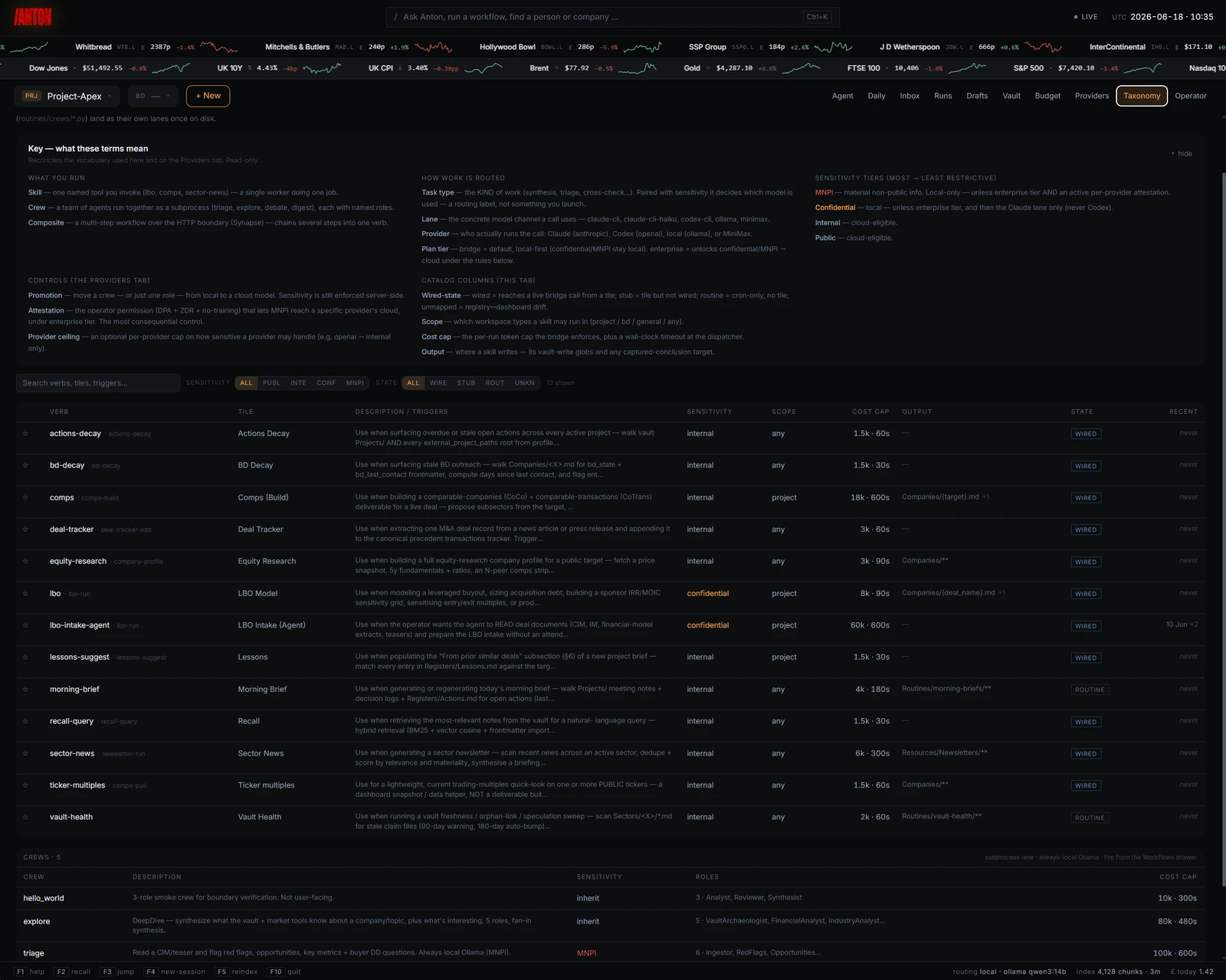
Skill and routine sensitivity taxonomy
Every skill carries a sensitivityThe taxonomy maps each skill and routine to a tier and an allowed lane — the rules the guard enforces, gathered in one place.
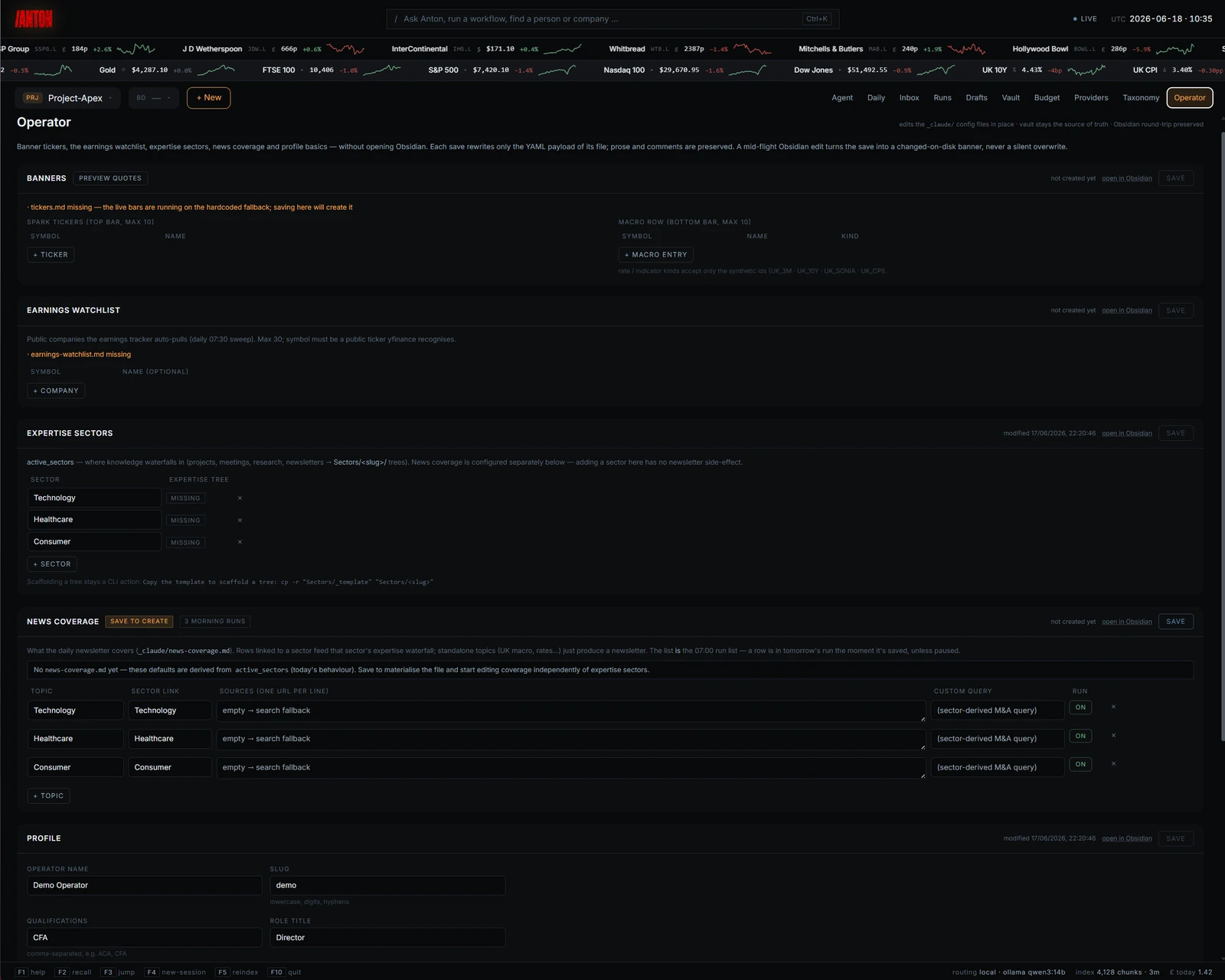
Operator profile, expertise sectors, watchlist and news coverage
Tuned to one operatorExpertise sectors, watchlists, news coverage, and a profile that shapes what ANTON drafts — all editable without opening Obsidian.

Executive Differentiation Matrix

Issue Generic AI Platforms ANTON
Valuation Engine Black-Box Computations: Relies on non-deterministic LLMs to calculate figures, leading to frequent mathematical hallucinations and broken dynamic formulas. Deterministic Execution: Zero numbers are computed by the LLM. Financial modeling tasks shell out to a native Python engine that drives versioned Excel templates (LBO, DCF, Comps) cell-by-cell.
Data Confidentiality Opaque Cloud Risk: Relies on generic cloud privacy policies; high operational risk of leaking sensitive Virtual Data Room (VDR) contents or deal parameters. Structurally Enforced Local Isolation: Governed by a strict sensitivity guard mapping files into four distinct tiers. Confidential and MNPI data tiers default to a local-only GPU, ensuring data never leaves the machine.
Execution Governance Unchecked Background Swarms: Opaque agentic loops execute hundreds of hidden background calls, generating highly unpredictable, non-repeatable outputs. Four Explicit Processing Lanes: The operator selects the exact lane (Chat, Single Skill, Composite, or Autonomous Crew) via specific verbs, dictating hard token ceilings and explicit determinism boundaries.
Budget Control Unmonitored Runaway Costs: Opaque architectures lack granular tracking, risking surprise API credit card overruns during intensive deal sprints. Granular Token Budgeting: Features strict monthly budget caps that can be configured globally, per individual model, or mapped directly to a specific deal project with proactive friction warnings.
Memory Governance Silent Database Overwrites: Automatically appends unverified data or vector embeddings to a shared database, creating unvouched facts and corrupting deal history. Principal-Gated Knowledge Base: Waterfall knowledge structure on a per project > per sector > expert essence, feeding from all available sources. System conclusions are delivered purely as isolated proposals. Fact updates to your permanent Markdown vault require explicit operator sign-off—never overwritten, never silent.
Institutional Audit Trail Opaque Operations: Opaque systems offer zero underlying insight into why a model arrived at a particular conclusion, making validation impossible. Comprehensive Telemetry: Every routine run and model call generates a structured, queryable trail through a sanitize-then-redact pipeline, logging provider, model, token cost, sensitivity tier, and execution lane.
Continuous Optimization Static Prompt Architectures: Requires manual, complex prompt engineering or expensive code-level adjustments to align with changing workflow preferences. Heuristic Feedback Loops: Actively monitors recurring follow-up query patterns to cluster behaviors and propose concrete, version-controlled modifications to its own underlying templates and operating rules.

Five layers that meet only across a boundary

Layers communicate over the filesystem, HTTP, or a subprocess — never by importing each other. That discipline keeps the math auditable, data contained, and the heavy engines swappable.

vaultmarkdown memory
Plain-Markdown canonical store — every note, decision, and source is a .md file with mandatory frontmatter. Git-managed; the file is the record.
routinesthe bridge
The FastAPI core — the only layer that touches everything. ~111 loopback endpoints, the scheduler, encrypted credentials, telemetry, and the governance core.
Governance core— sensitivity guard · cost gate · audit. Every lane passes through here.
enginevaluation
A Python wrapper that drives Excel templates through a cell-map registry. It computes and self-checks; the model only picks inputs and narrates.
dashboardcockpit
A React + TypeScript cockpit — chat shell, workflow tiles, an inbox of pending proposals, burn-rate and routing panels.
sidecarscomposite · crew
Two heavier orchestration runtimes kept out-of-process — reached over HTTP or a subprocess, never vendored in.
ANTON end-to-end architecture Operator inputs flow through ingestion routines into the Markdown vault. The vault is indexed into a local embedding index and served by the FastAPI bridge (API and dispatch plus the governance core: sensitivity guard, cost gate, audit). The guard routes sensitive work to a local on-device LLM and non-sensitive work to a cloud lane; a deterministic Excel engine does the maths. Four dispatch lanes feed read-and-synthesis outputs, and a learning loop proposes operator-gated rule edits appended back to the vault on approval. FastAPI bridge · loopback only atomic write · frontmatter contract indexed typed HTTP operator-gated proposal appended on approval default · all sensitive work only if non-sensitive AND plan-tier permits recurring follow-ups Operator inputs — meetings, web, documents, notes Ingestion routines — transcripts, news, PDF intake, extractors The Vault — Markdown canonical memory Local embedding index React dashboard API and dispatch Governance core — sensitivity guard, cost gate, audit Valuation engine — Excel templates, deterministic Local LLM · on-device GPU Cloud LLM lane Four dispatch lanes — chat · skill · composite · crew Read and synthesis — dashboard, Obsidian, recall, briefs Learning loop — proposes rule edits, operator-gated

The guard is one before_llm_call hook registered at startup. A single skill, a step inside a composite, and every role inside a crew all flow through it. No lane bypasses it.

One request, one lane — and you choose it

In the current LLM environment there is a tradeoff between intelligence (quality), privacy (LLM providers using data to train their models) and cost (API/subscription for cloud; very high costs for local hardware). Anton gives the operator the flexibility to use any provider or mix providers including local LLM to maximise budget.

Chat

type in the composer
Determinism
Latency
2–10s
LLM calls
1

Single skill

/recall · /comps · /lbo
Determinism
Latency
3–30s
LLM calls
0–1

Composite

/pitch · /teaser · /ic-memo
Determinism
Latency
minutes
LLM calls
declared

Autonomous crew

/triage · /explore · /debate
Determinism
Latency
minutes
LLM calls
10s–100s

Determinism = will the same request give the same answer? More bars = more repeatable (a fixed engine call); fewer = emergent (agents reason freely, so output varies). The left lanes are cheap and exact; the right lanes are powerful but variable.

Confidentiality level decides where a model may run

Every note carries a tier. The guard maps tier to an allowed lane before dispatch, and defaults to the more restrictive lane when uncertain.

public
Listed-company financials, press releases, sector statistics.
any cloud lane
internal
Your internal thesis on public material; no confidential party names.
cloud frontier model
confidential
Project codenames, target & sponsor names, NDA contents, VDR docs.
local only
MNPI
Pre-announcement results, embargoed news, inside information.
never leaves

Single-operator, local-first, genuinely in use

A work in progress, shared for review. Honest about what's live and what isn't.

Live today

  • Three of the four lanes — chat, single skills, and 4 autonomous crews running.
  • ~111 endpoints across 49 router files; 3,871 tests across 249 files.
  • Overnight automations — briefings, trackers, sector reads.
  • LBO end-to-end through the engine, captured back to the vault as a gated proposal.
  • Valuation comparables — Anton will understand target and identify comparable transactions and listed companies & provide strategic rationale for operator's approval.
  • Per-task routing, operator override windows, budget gating, per-provider ceilings.

In Progress

  • Buyer tracking & NDA — pending skill to track buyer engagement from email and batch personalised draft NDAs (Python engine, not LLM).
  • Composite lane — composite actions (pitch, teaser, IC paper).
  • DCF — blocked on per-template engine authoring.
  • Outlook & calendar ingestion — pending Microsoft Graph app registration.
  • Cross-machine deploy — local-first by design; no managed service.
  • HoT & SPA review — implement skill to draft Heads of Terms (based on learnings & expertise) and review SPA.

"He grimly does his work and sits motionless until it's time to work again, we can all take a page from his book" - Gilfoyle Bertram